From Tools to Teammates: Agentic AI Driving Smarter Workflows

Amany Atef

Agentic AI Use Cases and Real-World Examples in 2026

AI is no longer just supporting work, it is starting to run it.

In 2026, the rise of Agentic AI marks a fundamental shift from passive tools to autonomous systems that can think, decide, and act. The question is no longer whether AI can help, but whether it can take ownership of entire workflows.

Organizations today are moving beyond experimentation and asking:

👉 Can AI run this process end-to-end?

This is where Agentic AI is redefining how work gets done.

What is Agentic AI?

Agentic AI refers to intelligent systems designed as autonomous agents that can:

  • Understand goals
  • Make decisions
  • Take actions
  • Learn from outcomes

> all with minimal human intervention.

These systems operate with context awareness, adaptability, and goal orientation, transforming AI from a tool into a digital workforce partner.

As highlighted: Agentic AI systems can gather information, analyze data, make decisions, and take actions toward completing a defined objective

Why Agentic AI Matters Now

The shift is already underway at enterprise scale:

  • By 2028, 33% of enterprise applications will include agentic AI
  • By 2029, up to 80% of customer service issues may be resolved autonomously
  • Organizations are evolving from automation → orchestration → autonomy

This is not just another AI trend, it’s a new operating model for organizations.

How Agentic AI Works?

Agentic AI operates through a continuous intelligent loop:

  1. Perceive

Collects and processes data from systems and environments

  • Reason

Uses LLMs and enterprise data to make decisions

  • Act

Executes tasks across platforms and tools

  • Learn

Continuously improves through feedback loops

This enables systems to adapt dynamically, not just follow predefined rules.

Agentic AI vs Traditional AI

Agentic AITraditional AI
Goal-drivenTask-driven
Autonomous decisionsRule-based
Adaptive learningStatic behavior
End-to-end workflowsIsolated tasks

Top Agentic AI Use Cases (2026)

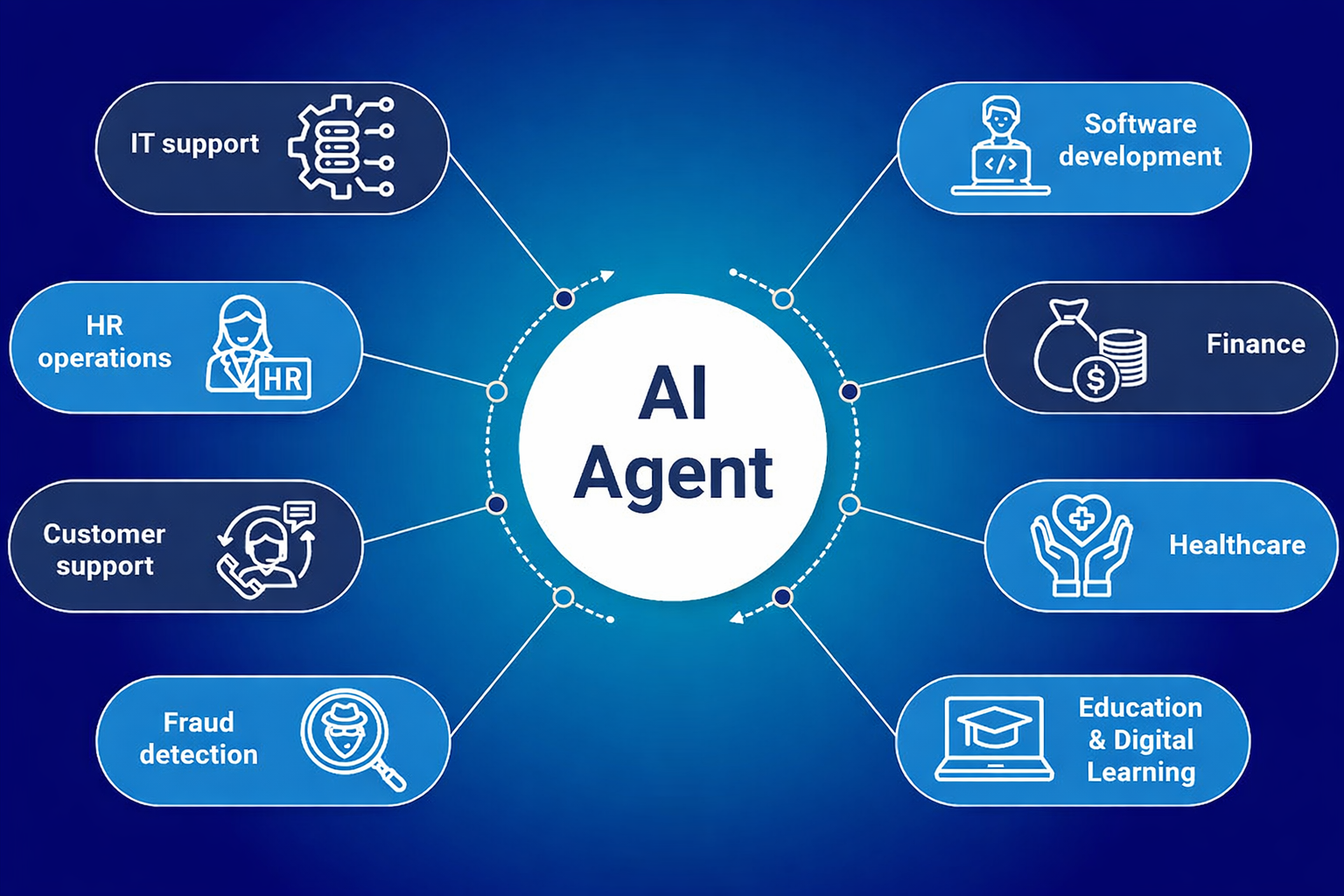
1. IT Operations & Service Management

Impact: Proactive issue resolution, automated support, reduced downtime

2. HR & Employee Experience

Impact: Automated recruitment, real-time employee support, personalized development

3. Customer Support & Experience

Impact: Intelligent conversations, proactive issue resolution, improved satisfaction

4. Cybersecurity & Fraud Detection

Impact: Real-time threat detection, automated response, risk prevention

5. Software Development (AI-Driven Engineering)

Impact: Faster releases, automated debugging, improved code quality

Industry-Specific Use Cases

Finance

Automated compliance, fraud detection, and personalized financial insights
👉 Outcome: Smarter financial decisions

Healthcare

AI-powered monitoring, virtual assistants, and predictive care
👉 Outcome: Better patient outcomes and efficiency

Legal

Automated case handling and compliance monitoring
👉 Outcome: Faster and more accurate legal operations

Education & Digital Learning (AI-Powered Learning Ecosystems)

The Challenge:
Traditional learning systems remain static, fragmented, and content-driven, with limited personalization and weak linkage to workforce outcomes.

Learners often experience:

  • One-size-fits-all content
  • Low engagement
  • Limited connection between learning and career growth

At the same time, institutions lack real-time visibility into skills, gaps, and impact.

How Agentic AI is Transforming Learning:

Agentic AI is shifting education from content delivery → capability orchestration.

Personalized Learning Pathways at Scale

AI agents:

  • Assess skills, roles, and goals
  • Recommend adaptive learning journeys
  • Continuously adjust learning paths

👉 Learning becomes dynamic and outcome-driven

AI Learning Coaches (Always-On Mentors)

AI-powered assistants:

  • Guide learners step by step
  • Provide instant feedback
  • Motivate and nudge learners

👉 Acting as 24/7 personalized mentors

Skills Intelligence & Workforce Insights

AI agents:

  • Identify skill gaps
  • Predict future needs
  • Support strategic workforce planning

👉 Learning becomes data-driven and strategic

Automated Learning Operations

Agentic AI automates:

  • Course recommendations
  • Enrollment and pathways
  • Assessment and feedback

👉 Reducing operational complexity

Learning in the Flow of Work

AI integrates learning into daily tools:

  • Provides knowledge at the moment of need
  • Embeds learning into workflows

👉 Learning becomes continuous and seamless

Real-World Direction (2026 and Beyond):

Leading institutions are moving toward:

  • AI-powered national learning platforms
  • Skills-based workforce ecosystems
  • Learning as Digital Public Infrastructure (DPI)

This transforms learning into a strategic capability engine, not just a training function.

Real-World Examples of Agentic AI

Johnson & Johnson

👉 Accelerating drug discovery through autonomous systems

Moody’s

👉 Multi-agent financial analysis improving decision accuracy

eBay

👉 AI agents enhancing development and marketplace efficiency

Deutsche Telekom

👉 AI-powered employee support at scale

Cosentino

👉 Digital workforce delivering 3–4x productivity gains

The Strategic Value of Agentic AI

Agentic AI is not just about efficiency, it’s about redefining how organizations operate.

Key Benefits:

  • End-to-end automation
  • Real-time intelligent decision-making
  • Hyper-personalization
  • Continuous, autonomous operations

It shifts AI from:

👉 Supporting workDriving outcomes

Final Thought: From AI Tools to AI Teammates

The true breakthrough of Agentic AI is simple:

AI is no longer just a tool, it’s becoming a digital teammate.

Organizations that embrace this shift early will:

  • Operate faster
  • Decide smarter
  • Scale effortlessly

The question is no longer “Should we adopt AI?”
It’s:

👉 “How fast can we build an agent-driven enterprise?”

Designed with WordPress

The Future of Digital Learning: Top Trends Shaping Education in 2025

Summary

As we move into 2025, the field of digital learning is evolving at an unprecedented pace. Staying updated on emerging technologies, innovative Learning methods, and educational paradigms is critical for educators, learners, and digital learning professionals.
This article explores the key trends that are redefining digital learning, offering insights into how they can enhance learner experience, engagement, accessibility, and overall learning effectiveness.

Emerging Technologies in Digital Learning for 2025

The rapid evolution of Digital Learning technologies continues to reshape how knowledge is delivered and consumed. Staying ahead of these changes is vital for leveraging innovations that can revolutionize learning experiences. Below are the top trends set to define Digital Learning in 2025:

Artificial Intelligence (AI) in Digital Learning

1. Personalized Learning Pathways
AI enables customized learning experiences by analyzing learner data to identify strengths and weaknesses. By recommending targeted resources and activities, AI creates personalized pathways that optimize learning outcomes, ensures that each learner receives the support they need on timely manner to succeed, making learning more effective and inclusive.

2. Intelligent Tutoring Systems (ITS)
AI-driven Intelligent Tutoring Systems (ITS) simulate one-on-one tutoring, providing real-time feedback and personalized guidance. This bridges gaps between traditional and online learning, enhancing engagement and support.

3. Automated Administrative Tasks
AI streamlines administrative processes such as grading, attendance tracking, and course management. Automating these tasks allows educators to focus on teaching and developing innovative methods.

Virtual & Augmented Reality (VR/AR)

1. Immersive Learning Experiences
VR transports learners to virtual environments, while AR overlays digital information onto the real world. Both technologies offer interactive, hands-on experiences that deepen understanding.

2. Enhanced Collaboration
VR and AR facilitate teamwork by enabling collaborative projects in virtual spaces, fostering a sense of community among learners and bridging remote and in-person interactions.

3. Real-World Applications
Integrating AR and VR into learning enables learners to apply their knowledge to real-world scenarios.
For example: medical learners can perform virtual surgical simulations, and engineering learners can design and test structures using augmented reality. These immersive, hands-on experiences deepen understanding, improve retention, and better prepare learners for their professional careers.

Gamification

1. Motivation and Engagement
By incorporating game-like elements such as points, badges, and leaderboards, gamification keeps learners motivated and invested in their education.

2. Skill Development
Gamification promotes critical thinking, problem-solving, and teamwork by presenting challenges that require creative solutions.

3. Real-Time Feedback
Gamified systems provide instant progress updates, enabling learners to adjust strategies and achieve their goals effectively.

Mobile Learning (mLearning)

1. Learning on the Go
Mobile learning leverages smartphones and tablets to deliver content anywhere, empowering learners to integrate education into their daily routines.

2. Responsive Design
Platforms adopt responsive design to optimize content for various devices, ensuring seamless access and user-friendly experiences.

3. Interactive Features
Touch-based navigation, multimedia elements, and gamified activities enhance engagement and make mobile learning dynamic.

Microlearning

1. Bite-Sized Content
Microlearning presents small, digestible modules, making it easier for learners to grasp and retain complex topics, especially for time-constrained professionals.

2. Flexibility and Accessibility
Learners can access content on their preferred devices anytime, anywhere. This adaptability ensures inclusivity and caters to various learning styles.

3. Increased Engagement
Interactive elements like quizzes, videos, and gamified activities make learning enjoyable, reinforcing key concepts and boosting retention.

Data-Driven Decision Making

1. Analytics and Insights
Digital Learning platforms gather data on learner performance and engagement, helping educators refine strategies and improve outcomes.

2. Personalized Learning Experiences
Analyzing data allows platforms to recommend tailored resources and activities, catering to individual learning needs.

3. Continuous Improvement
Regular data analysis enables Digital Learning providers to identify gaps and enhance platforms, ensuring they remain effective and relevant.

Adaptive Learning

1. Personalized Learning Paths
Adaptive systems continuously adjust content based on learner progress, ensuring a tailored learning experience.

2. Real-Time Adjustments
These systems identify struggling learners and provide additional support, improving comprehension and retention.

3. Improved Retention
Adaptive learning fosters long-term understanding by addressing individual needs and ensuring mastery of concepts.

Blockchain in Education

1. Secure Credentialing
Blockchain ensures tamper-proof educational credentials, enhancing trust and simplifying verification for learners and employers.

2. Decentralized Learning Records
Comprehensive, blockchain-based learning records track achievements across a learner’s educational journey, opening new opportunities.

3. Increased Trust and Transparency
Blockchain builds confidence in educational credentials, reducing fraud and streamlining processes.

Social Learning

1. Collaborative Learning Environments
Digital Learning platforms create spaces for learners to collaborate on projects, share resources, and participate in discussions, fostering community and engagement.

2. Peer-to-Peer Learning
Learners learn from one another through peer-to-peer interactions, developing communication and teamwork skills while reinforcing their knowledge.

3. Social Media Integration
Integrating platforms like LinkedIn and Twitter enhances connectivity, enabling learners to share insights and participate in broader educational discussions.

Conclusion

The future of Digital Learning in 2025 is marked by rapid innovation and transformation. Emerging technologies like AI, VR/AR, and blockchain, along with methodologies such as microlearning, gamification, and social learning, are set to redefine education. By embracing these trends, educators and institutions can deliver more engaging, accessible, and effective learning experiences, positioning themselves at the forefront of this dynamic field.


By Amany Atef
Smart Learning Futurist & Innovation Strategist

Learn Smarter, Not Harder: How ChatGPT Can Transform Your Learning Experience!


Introduction

ChatGPT can serve as your personal learning buddy and teaching assistant. By using the right prompts, you can save time, increase your learning and earnings, and enjoy your work more. OpenAI’s flagship platform excels at facilitating learning, acting like a tutor, comprehensive textbook, or wise mentor—only much faster. With a bit of guidance—specifically in mastering prompt writing—ChatGPT can help you learn new things significantly more efficiently than traditional methods. Here are my favorite ways to use ChatGPT for learning, enabling you to master any subject 100X faster!

Here you Go…. 😉

1. Research Assistance

Research is a cornerstone of effective learning, and ChatGPT excels in this area. By leveraging its extensive knowledge base, ChatGPT can provide reliable sources and key concepts for any topic you are studying.

Prompts:

  • What are some key terms I should know about [topic]?
  • Provide me with some reliable sources to learn about [topic].
  • Act as a research assistant and provide me with five reliable sources on [topic].

Example:
If you’re studying climate change, ChatGPT can offer sources, define key terms, and highlight important concepts, making your research process more efficient and thorough.

2. Definitions and Explanations

Understanding new terms and concepts is crucial for learning. ChatGPT can provide clear, concise definitions and explanations, along with real-world examples to enhance comprehension.

Prompts:

  • What does [term] mean?
  • Can you explain [concept] to me?
  • Define [term] and provide an example.

Example:
For instance, if you’re learning about “blockchain,” ChatGPT can define the term, explain its significance, and provide examples of its applications.

3. Answering Specific Questions

When you’re unsure about a specific concept or idea, ChatGPT can provide detailed answers to your questions, helping you understand complex topics better.

Prompts:

  • What are the best practices for [topic]?
  • What are the advantages and disadvantages of [concept]?
  • Can you give me some examples of [topic] in real life?

Example:
If you’re curious about the benefits of renewable energy, ChatGPT can list advantages, provide case studies, and suggest best practices for implementation.

4. Summarizing Complex Topics

Digesting large volumes of information can be overwhelming. ChatGPT can summarize articles, books, or complex ideas into more manageable pieces.

Prompts:

  • Describe the main points of [book] in a few sentences.
  • Craft a brief summary of [topic].
  • Summarize in a few short sentences: [sentence].

Example:
For a lengthy research paper on quantum computing, ChatGPT can distill the key points, making it easier for you to grasp the essential information quickly.

5. Learning New Skills

ChatGPT can provide step-by-step instructions, tips, and exercises for learning new skills, from languages to technical abilities.

Prompts:

  • Give me step-by-step instructions on how to learn [skill].
  • Explain the basics of [subject] for beginners.
  • Can you provide me with some exercises to practice [skill]?

Example:
If you’re learning Spanish, ChatGPT can offer vocabulary exercises, pronunciation tips, and grammar rules to help you progress.

6. Recommending Resources

Beyond answering questions, ChatGPT can suggest books, articles, apps, and other resources to deepen your knowledge on any subject.

Prompts:

  • Give me some book recommendations on [topic].
  • Can you recommend some blogs to follow for [topic]?
  • Suggest three apps for learning [language].

Example:
For someone interested in digital marketing, ChatGPT can recommend the latest books, influential blogs, and useful apps to enhance their learning.

7. Exploring Related Topics

To gain a comprehensive understanding, exploring related subjects is essential. ChatGPT can help you delve into connected areas and broaden your perspective.

Prompts:

  • List some related topics to [subject] that I should explore.
  • Describe the relationship between [concept1] and [concept2].
  • Explain how [subject] relates to [field].

Example:
If you’re studying artificial intelligence, ChatGPT can suggest exploring machine learning, data science, and their applications in various industries.

8. Practice Exercises

Engaging in practice exercises is crucial for reinforcing learning. ChatGPT can generate quizzes, fill-in-the-blank exercises, and other practice activities.

Prompts:

  • Create a quiz on [topic] with ten questions.
  • Generate a fill-in-the-blank exercise on [concept].
  • Come up with a multiple-choice exercise to test knowledge of [skill].

Example:
For someone studying biology, ChatGPT can create quizzes on cell structure, genetics, and other key areas to test and reinforce their knowledge.

9. General Tips and Advice

ChatGPT offers general tips and advice on effective learning strategies, time management, and staying motivated.

Prompts:

  • Describe some effective study strategies for [subject].
  • Give me tips on how to stay motivated while learning [topic].
  • Explain how to manage time effectively when studying [subject].

Example:
If you’re preparing for exams, ChatGPT can provide advice on creating a study schedule, staying organized, and maintaining focus and motivation.

10. Simplify Complex Information

Breaking down complex subjects into smaller, more digestible parts is key to understanding. ChatGPT can use analogies and real-life examples to simplify difficult concepts.

Prompts:

  • Break down [subject/topic] into easier-to-understand parts. Use analogies and real-life examples to simplify the concept and make it more relatable.

Example:
Instead of scrolling through YouTube for videos or searching for explainer articles, ChatGPT can quickly help you grasp the basics of complicated subjects in a memorable way.

11. Create a Study Plan

Organizing your study time effectively can significantly enhance your learning experience. ChatGPT can help you design a study plan, including breaks and practice exercises.

Prompts:

  • I need help organizing my study time for [subject/topic]. Can you create a study plan for me, including breaks and practice exercises?

Example:
Even without upcoming exams, a well-structured study plan allows you to delve deep into any subject of interest, expanding your knowledge and broadening your horizons.

12. Memorize Key Information

Memorization techniques are essential for retaining important facts, dates, or formulas. ChatGPT can help you develop effective strategies for memorization.

Prompts:

  • What are the most important facts, dates, or formulas related to [topic]? Help me create a memorization technique to remember them easily.

Example:
From creating memorable rhymes to crafting stories related to the topic, ChatGPT can enhance your ability to absorb and remember crucial information for any event.

13. Apply Your Knowledge

Applying what you’ve learned to real-world problems is a great way to deepen your understanding. ChatGPT can guide you through this process.

Prompts:

  • Use your knowledge of [topic] to solve a real-world problem. Explain your thought process and share your solution.

Example:
Exploring how your existing knowledge can be applied in various contexts can open doors to new opportunities and career paths.

14. Compare and Contrast

Understanding the similarities and differences between two concepts can provide deeper insights. ChatGPT can help you compare and contrast different ideas.

Prompts:

  • Compare and contrast [concept 1] and [concept 2] to better understand their similarities and differences. Use examples to illustrate your points.

Example:
By examining both concepts thoroughly, ChatGPT can help you understand their similarities and differences comprehensively.

15. Learn from ‘Future’ Mistakes

Evaluating potential mistakes and learning from them is crucial for growth. ChatGPT can help you analyze errors and improve your understanding.

Prompts:

  • I made a mistake while practicing [skill]. [Describe the mistake if you can]. Can you explain what went wrong and how I can avoid making the same mistake in the future?

Example:
By actively engaging in this process, you can gain valuable insights and perspectives, enriching your learning journey.

16. Summarize Long Texts

When faced with lengthy articles or papers, summarizing key points can save time. ChatGPT can distill the essential information for you.

Prompts:

  • I need to read a complicated article related to [topic]. Here is the content [insert content]. Can you help me summarize the key points and takeaways from the text?

Example:
Instead of spending hours reading through long articles, ChatGPT can provide a concise summary, allowing you to stay informed without sacrificing too much time.


Conclusion
:

ChatGPT is a versatile tool for anyone looking to master new topics and skills. By utilizing its capabilities, you can enhance your learning experience, save time, and achieve your educational goals more efficiently. Give ChatGPT a try today and unlock the power of AI for your learning journey.

By integrating ChatGPT into your learning routine, you can transform how you acquire knowledge and skills. Explore the prompts, tips, and examples provided to make the most out of this cutting-edge AI tool.

Remember.. Learn Smarter, Not Harder! 😉


About the Author:

Amany Atef is a seasoned professional with expertise in digital learning, innovative pedagogy, and project management. She shares her insights on EdTech, smart learning, and technology in education.

Follow me:
 LinkedIn: Amany Atef, MBA, MBA
 X-Twitter: @AmanyAtef


Subscribe for More Insights

Stay updated with the latest tips, strategies, and insights on mastering new skills and topics by subscribing to our blog. Don’t miss out on the valuable content that can help you learn faster and smarter.


Major Educational Shifts on the Horizon for Late 2024: Emerging Trends to Watch

As we move further into 2024, the EdTech landscape is undergoing a dramatic transformation with innovative trends redefining how education is delivered and experienced.


1. AI in Educational Predictive Analytics

AI’s predictive analytics capabilities are empowering educators to anticipate learner outcomes and identify those who may need additional support. By leveraging these insights, educators can tailor their lessons and interventions to individual learners, significantly enhancing academic success rates.

2. Blockchain Integration in Education

Blockchain technology is becoming a key player in enhancing security and transparency in education institutions. It ensures the authenticity of certificates and credentials, preventing fraud and easing verification. Additionally, blockchain facilitates smart contracts for online course payments and enrollments, streamlining administrative processes.

3. Augmented Reality (AR) for Outdoor Learning

While AR has been used in classrooms for some time, 2024 is seeing a surge in its application for outdoor experiential learning. AR apps overlay educational content on real-world settings, allowing learners to explore subjects like history, geography, and science in an interactive and engaging way. This trend promotes physical activity and discovery.

4. Eco-Friendly EdTech: Fostering Sustainable Classrooms

Sustainability has become a focal point in educational technology. Institutions are increasingly adopting green practices, such as using energy-efficient devices, digital textbooks to reduce paper consumption, and energy-efficient server solutions. These initiatives aim to minimize environmental impact while integrating technology into education.

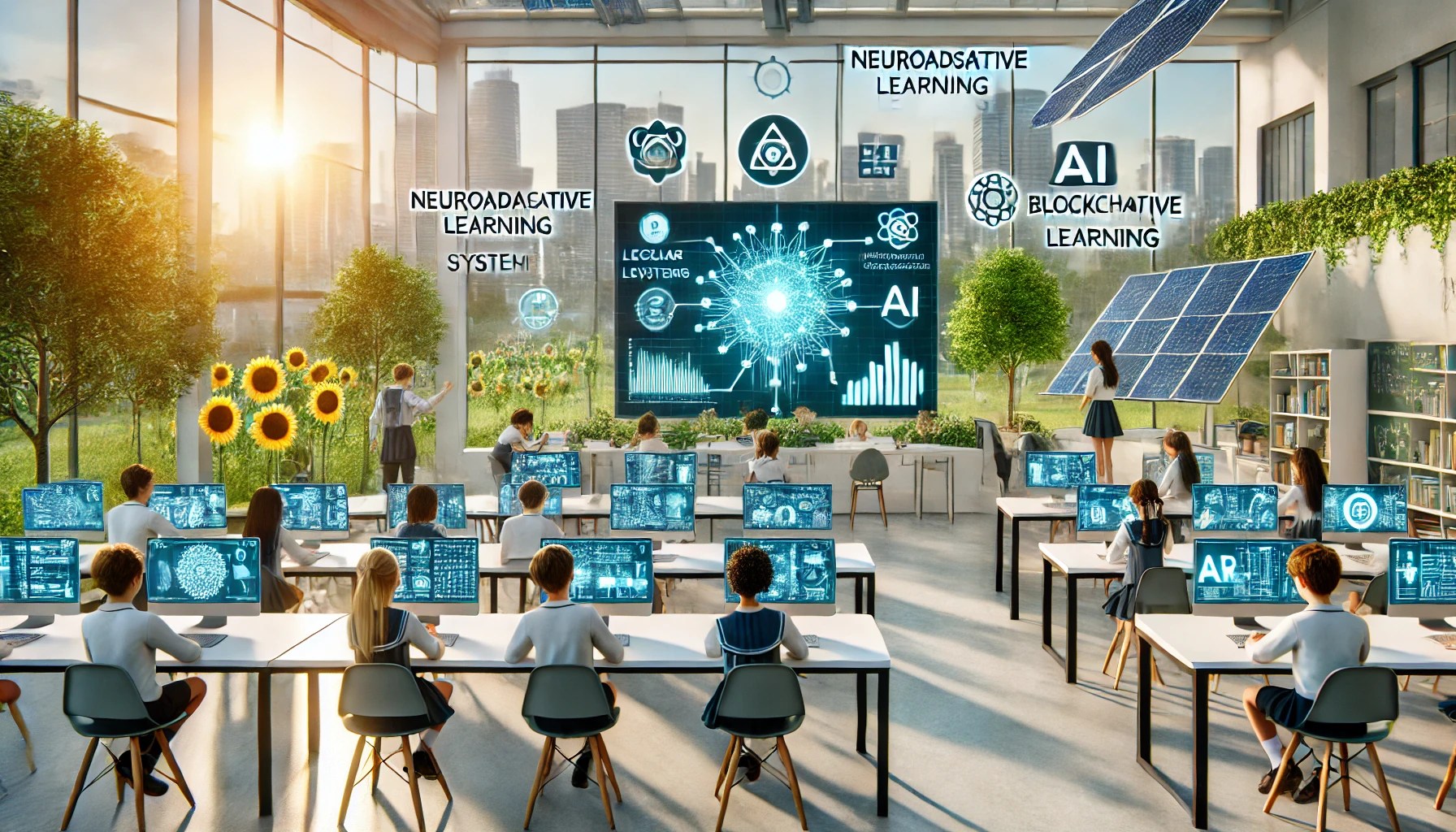
5. Neuroadaptive Learning Systems

Neuroadaptive learning systems tailor the educational experience to learners’ mental and emotional states. These systems monitor physiological data like heart rate and respiration to gauge workload capacity and learning speed. This personalized approach helps create an optimal learning environment, maximizing engagement and efficiency without overwhelming learners.

6. The Rise of BYOD: Boosting Student Engagement

The Bring Your Own Device (BYOD) initiative is gaining traction in class this year. By allowing learners to bring their personal devices to class, institutions save on technology costs while enhancing learner engagement. This approach fosters personalized learning experiences by enabling the use of a diverse array of educational apps and resources.

——————————–

Amany Atef, Smart Learning Expert
Dubai, UAE

EdTech Trends For 2022

Emerging technologies reshaped and transformed the educational sector in terms of teaching and learning. Let’s take a look at some of EdTech trends for 2022:

1. Innovative eLearning Platforms

It’s fair to say that eLearning has been in the picture for a while, however, the trends in education are constantly evolving and becoming more and more popular. The classes for an online degree are no longer tedious video lectures, but they include peer communication and effective interaction.

Various educational institutions are now trying to increase learner engagement through remote learning platforms. Not just innovation, an education institution curriculum should also follow the latest education trends happening in the outside world.

2. AI-Driven Teaching Programs

Business and healthcare are two industries that are seeing the rise of more and more artificial intelligence (AI) programs. However, the educational sector is not far behind. The use of automated grading systems and AI teaching assistants is on the rise and it gives us an overview of the future trends in education.

Question Bot, built by David Kellerman, is a great example of an AI in action. Initially, implemented in the University of New South Wales, the question bot was programmed to provide answers to learners’ questions and deliver past videos of lectures. The machine learning abilities of the bot ensure that it gets better with more exposure to different queries. (This is just one example that showcases the immense potential of AI in education. The tedious, boring tasks can be taken care of by automation and the instructors can focus on the complex ones.)

3. Immersive Learning with VR/AR

VR/AR technology is mostly known for its fun and interactive games in the educational sector. However, it is not just confined to that. A journalist from the University of Maryland writes that this technology can prove wonders with a learner’s attention span.

This technology helps learners to eliminate distractions and immerse themselves in their work. It’s also a very handy tool for learners with ADD/ADHD, since VR equipment has the ability to fully immerse the user in its digital landscape.

4. Gamification

The process of gamification is one of the new trends in education. More and more educators are now choosing to gamify their lessons. This is handy in getting learners engaged and deriving maximum interest and excitement towards learning.

A great example of this is Moonshot Jr’s Moonpreneur – business strategy board game, one of the rising education trends. Moonpreneur is an educational board game that has helped hundreds of children, young adults, and adults gain financial literacy and stimulate an entrepreneurial mindset in a fun way.
This educational and fun board game makes learning financial concepts entertaining for children, who otherwise, don’t get a chance to indulge in it.

5. Learning Analytics

Data is valuable, and finally, the educational sector is beginning to notice. Analytics allows educators to be more in command as to how to best teach their learners. Educators gain insights via acquiring learner feedback from surveys.

This also ensures the learners that their voice matters and is of importance to someone who they value. Thus, learning analytics helps teachers as well as learners to keep the engagement going.

6. Blockchain Innovation

Blockchain’s Distributed Ledger Technology (DLT) provides umpteen number of advantages to education, especially data storage. With the addition of new data, a new ‘block’ is created. Therefore, making the storage theoretically infinite.

e-Portfolios and Massive Open Online Courses (MOOCs) use Blockchain technology to validate knowledge. In terms of the eLearning organizations’ scalability, authentication, and pricing issues, DLT technologies bestow solutions.

7. Chatbots

Are you seeking professional consultation regarding academic papers or in-depth help on essay writing? Chatbots are here to make your life easier. Just follow the bot’s recommendations and in a matter of a few clicks, you’ll be there. Chatbots’ power lies in their simplicity.

You can find them in Frequently Asked Questions (FAQs), in articles, and in other important content.

8. Video-assistive learning

This form of learning has grown in popularity over the recent years. With the internet and digital gadgets around, videos have become of prime importance. Videos have the tendency to make learning more engaging, fluid, and interactive.
The teachers’ burden decreases while the results of the learners get better. In today’s day and age, an incredible number of more than 2.3 billion people watch videos for education and entertainment purposes.

Conclusion

It is clear that educational technology trends are completely transforming the educational sector in terms of teaching and learning. While learning has become more accessible and convenient, the aspirations have also turned a notch higher.

Modern technology and new trends in education provide us with solutions for every crisis as we’ve seen in the case of the Covid-19 pandemic. Learners have been able to connect virtually with one another and continue their studies. Not too long ago, we could not have imagined something like this.

Now, it is important to understand that we need to prepare learners for the future of work, and the nature of the future of work will be different… Are we ready for the new normal?

AI In Education

Artificial-intelligence-696x324

Here is a glimpse into some of the roles it will play in the classroom.

1.Automate Grading

With AI, the role of grader can be passed along. Current AI technology is already able to automate grading of multiple choice materials, also AI will be able to grade more than standardized assessments.

2. Support Teachers

For example, one college professor successfully used an AI chatbot to communicate with students as a teaching assistant all semester without students knowing they were not talking to a human.

3. Support Students

Next generation of students will grow up with an AI companion that knows their personal history and school history.

4. Meet a Variety of Student Needs

In addition to acting as a personalized learning companion, AI will also be able to help students with special needs by adapting materials to lead them to success.

5. Allow Teachers to Act as Learning Motivators

As AI takes on more of a teaching role by providing students with basic information, it will change the role of teachers in the classroom. Teachers will move into the role of classroom facilitator or learning motivator.

6. Provide Personalized Help

AI will also provide personalized tutoring for students outside of the classroom. When students need to reinforce skills or master ideas before an assessment, AI will be able to provide students with the additional tools they need for success.

7. Identify Weaknesses in the Classroom

AI will also work in identifying classroom weaknesses. For instance, AI will identify when groups of students miss certain questions letting the teacher know when material needs to be retaught. In this way, AI will also hold teachers accountable and strengthen the best teaching practices.

While artificial intelligence will not replace teachers altogether, it is possible that it will reshape the way teachers teach and students learn.


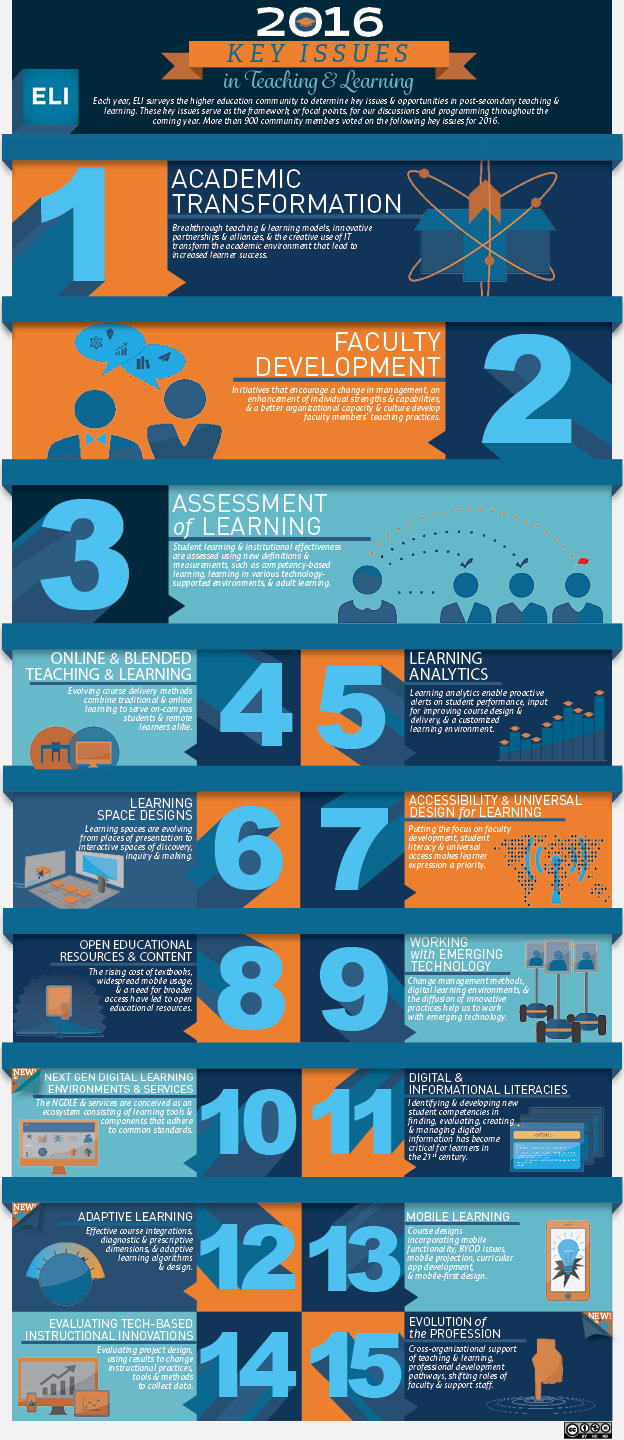
Key Issues in Teaching & Learning 2016

These key issues serve as the framework, More than 900 community members voted on the following key issues for 2016:

2016

  1. Academic Trasformation
  1. Faculty Development
  1. Assessment of Learning
  1. Online and Blended Learning
  1. Learning Analytics
  1. Learning Space Design
  1. Accessibility & Universal Design for Learning 
  1. Open Educational Resources & Content
  1. Working with Emerging Technology
  1. Next Gen Digital Learning Environments (NGDLE) & Services
  1. Digital & Informational Literacies
  1. Adaptive Learning
  1. Mobile Learning
  1. Evaluating Tech-Based Instructional Innovations
  1. Evolution of the Profession


Source: Educause: http://goo.gl/ZvjVRW  

eLearning in 2016: Influential Trends

Many large, ambitious organizations will be looking closely at their plans for elearning in 2016. Online training looks set to continue growing as part of an overall strategy to gain competitive advantage, and the use of elearning is rapidly expanding, replacing or supplementing traditional classroom learning. An annual growth rate of 7.9% since 2012 is expected by many to bring the global investment in elearning to over $50 billion per year by the end of 2016.

As is common in a booming industry, a lot of new developments and trends are popping up in the field of elearning, with companies that need to onboard, train and ensure compliance from a large workforce looking not only at online vs traditional training, but how to make best use of the technology and techniques available.

Let’s have a look at some of the most important trends in online training that could and should be influential in planning your elearning in 2016.

Gamification

Gamification is not a completely new trend, but it has been gaining some serious traction in the last few years. More and more research is indicating that incorporating game dynamics into an e-learning program can enhance learning outcomes significantly.

Developing effective games for online training courses is still a time-expensive process that, if not performed correctly, won’t bring the desired results. To make sure you use gamification effectively, it is important that the elearning games are based on proven learning research.

More and more elearning consultancies are specializing in gamification, bringing better and more cost-effective solutions to the market. This makes it more interesting for organisations to hop on the gamification band wagon.

We predict that in 2016, gamification is really going to take off. If you’ve not been experimenting with gamified learning yet, now is the time to get started.

Big Data

Big Data is the buzzword in most technology-focused these days, including the elearning industry.

Big Data analytics tools are getting more and more sophisticated, but also easier and cheaper to use. Analysing your organisation’s learning data and combining it with external learning data sources can provide important insights about your e-learning programs and how to go about improving course content and optimizing your learning strategy.

By analysing individual and group learning patterns, courses can be personalised in a way that realises the best learning results for both the individual and the organization as a whole.

The more data is being stored and the more advanced Big Data analytics tools become, the more useful it will be for elearning. It may be just the right time to start looking at using Big Data to improve your elearning programs.

Cloud e-Learning

Many organizations have already migrated to a cloud e-learning solution, but it looks like cloud computing will become even more important in 2016. Organizations that have been reluctant to adopt cloud technology (often due to security concerns) are changing their attitudes.

The added functionalities, ease of use and uncomplicated maintenance that cloud software offers will convince even more organisations to make the switch in 2016.

Social Learning

Social media isn’t just for sharing your latest holiday or party photos. It can also be used as an effective personal learning tool. Social media is already being used as a tool for connecting with people that work across international teams or within complementary organizations within the same industry, sharing and discussing ideas, and collaborating on projects.

There are many ways in which social media can aid with learning. For example, Facebook groups can be used in an eLearning course to discuss learning topics and make it easier for student to help each other out without having to be in the same room. Twitter can be used to get in touch with subject matter experts, stir up discussions and curate interesting content about the eLearning topic.

We believe that social media will play an ever more important role in learning throughout 2016 and beyond.

Automation in eLearning Course Development

Right now, elearning design and creation is still a very time intensive process. This may change significantly in the next few years though. Automated content creation solutions are becoming more and more sophisticated, allowing content providers to create and curate great elearning content with minimal effort.

elearning elements that used to take a long time to develop, such as exercises, quizzes, tests and games, can now be generated using automated solutions. The most advanced tools scan the course content and determine which are the most important parts to be included in tests.

These solutions will only get better, allowing for significant time and cost savings in the development of elearning courses. They can also provide a more individualized learning experience by analyzing a student’s performance and learning preferences. Based on this information, course content (including tests) can be personalized.

Augmented Reality

While 2016 may not yet see an explosion of augmented reality use within elearning, it is an area that is under intense development. Augmented reality devices such as Google Glass and Oculus Rift may become part of everyday life in the future and will surely become more popular in elearning.

These devices allow environments to be adapted (virtually) to improve the learning experience. For example, an online course about astronomy could use augmented reality glasses to give a tour of the moon without the student having to leave their home or office. For a French class, the glasses could display a French classroom, better immersing the student in the language learning process.

Augmented reality is still very much in its infancy, but the potential uses are fascinating.

Personalized Learning

One thing that comes up with most of the trends discussed above is that of personalized elearning:

  • Automated eLearning tools are already using (big) data to create a more personalized learning experience.
  • Cloud eLearning solutions allow individuals to study at times when it suits them best and from wherever they feel most comfortable.
  • Using social media for learning allows the individual to enhance their learning experience in whichever way helps them most.

More personalized learning will allow students to achieve better results and have a more enjoyable learning experience. In most cases it will also allow them shorten the learning time frame.

If you’ve let all of the trends discussed above pass by until now, it may be time to look into modernizing your organization’s elearning strategy. While some of these trends are still very complicated or expensive to implement, others are already quite mature and require a minimal effort for a potentially great ROI.

One thing that is 100% certain is that exciting times are ahead in the elearning industry, and the world’s largest and most progressive organizations will be the first to adopt them.